
Also available in:
 Deutsch (German)
Banners, guest articles and affiliate links are important ways to promote offers in the Adult Biz. But how should paid links be labelled? Our clear recommendation is rel="sponsored"—for text links as well as banners. Here’s what that means and what publishers and advertisers should keep in mind.
In brief
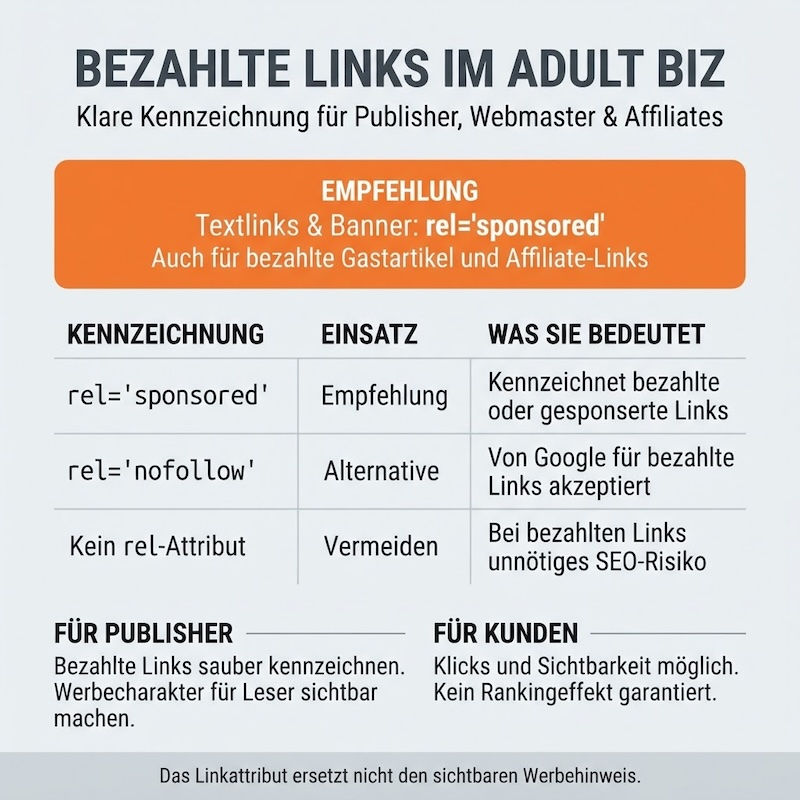
Paid links are an important advertising and affiliate tool in the Adult Biz. They can bring visitors to operator websites, shops and platforms, but they should not be used as purchased ranking signals. Google accepts rel="sponsored" or rel="nofollow" for paid links. Our recommendation is to use rel="sponsored" for paid text links and banners. The same applies to paid guest articles and affiliate links. An unmarked link is often called “dofollow”—but that is not recommended for paid placements. rel="nofollow" is an accepted alternative, but it is less specific to sponsorship. The link attribute does not replace a visible advertising disclosure. Sell reach and visibility—not a guaranteed SEO effect.
One link, two separate requirements: advertising and SEO
Paid placements are part of everyday business in the Adult Biz: operators book banners, webmasters publish sponsored articles, and affiliate partners earn commissions on referrals or sales. The formats differ, but the key question is the same: how should a commercial link be labelled?
There are two separate requirements. In the HTML, the link is qualified for search engines. For readers, the commercial nature of the content must be clearly visible. A notice such as “Advertisement” or “Sponsored” serves a different purpose from the link attribute and does not replace it.
Google lists rel="sponsored" and rel="nofollow" as ways to qualify paid links.[1] For new paid placements, sponsored is the clearer choice: it indicates that the link is part of an advertisement, sponsorship or other commercial arrangement.
Our recommendation: rel="sponsored"
For paid text links and banner links, we recommend rel="sponsored". It most accurately describes the purpose of the link, making it a good fit for sponsored guest articles, ads and affiliate links.
A paid text link could look like this:
<a href="https://example.com" rel="sponsored">View offer</a>
For a linked banner, add the attribute to the clickable link:
<a href="https://example.com" rel="sponsored">
  <img src="banner.jpg" alt="Advertisement for Example">
</a>
The attribute should be placed on the link, not just on the image. If a click first goes through a tracking or redirect link, that link should also be qualified accordingly.
sponsored, nofollow and dofollow compared
| Option | What it means | Implications for the publisher | Implications for the advertiser |
|---|---|---|---|
rel="sponsored" | Explicitly identifies a link as paid or sponsored. Our recommendation for paid text and banner links. | Makes the commercial relationship clear to search engines and reduces the risk of the link being treated as an attempt to manipulate rankings. | The link can still attract visitors and visibility. No specific SEO ranking effect is guaranteed. |
rel="nofollow" | A general qualification that Google also accepts for paid links. | An acceptable alternative, but less specific than sponsored. | Clicks and visibility are still possible. It does not provide a reliable ranking benefit. |
No rel attribute (“dofollow”) | A regular link without a qualifying attribute. “Dofollow” is not a separate HTML attribute. | Paid placements carry a risk of violating Google’s guidelines. Google may ignore such links or take action against the websites involved. | The advertiser is not guaranteed an SEO benefit. Google may ignore the link, and manipulative link patterns can also create problems for the linked site. |
The attribute does not guarantee that Google will completely ignore a link or that it will count particular ranking signals. Publishers and advertisers should therefore not promise a guaranteed ranking boost in exchange for a paid placement.[1]
What matters particularly in the Adult Biz
Flat fee, commission or another form of compensation?
A paid placement is not limited to a banner sold for a fixed price. Affiliate arrangements can also involve a commercial relationship—for example, when a webmaster earns a commission for sign-ups, purchases or other actions. These affiliate links should also use rel="sponsored".
Keep track of tracking links and redirects
In the Adult Biz, links often do not lead directly to the advertised destination. They may pass through tracking links, affiliate networks or redirects. Keep a record of who booked the placement, where the click leads and which redirects are involved.
Check destinations regularly. A redirect may change, an offer may expire or a domain may change hands. An old advertising link could then lead to a page that no longer matches the ad or the original agreement.
Guest articles must be recognisable as advertising
A paid guest article can be informative and written in an editorial style. If it is published in exchange for payment or other compensation, its advertising nature should still be clear to readers. A visible notice such as “Advertisement,” “Sponsored” or “Sponsored article” is not the same as rel="sponsored; each has a separate role.
In Germany, Section 6 of the Digital Services Act (DDG) sets transparency requirements for commercial communications.[2] The appropriate disclosure can depend on the format and circumstances of publication.
Check the destination and the offer
Before publication, the publisher should check that the offer and destination page are appropriate for the placement. Offers, access conditions and target audiences can vary considerably in the Adult Biz. Clear information about the brand, working redirects and suitable age or access notices can help prevent misunderstandings.
What publishers and advertisers should agree on
Before a campaign goes live, put the key details in writing: the advertising format and duration, visible advertising disclosure, destination URL, tracking and redirects, and the technical link qualification. It should also be clear who can request changes to the link or destination page.
Publishers should keep a record of paid links and affiliate links and review them again if anything changes. Advertisers, in turn, should not expect unmarked links or guaranteed SEO results from a reputable placement.
Conclusion: use sponsored for paid text and banner links
For paid text links and banner links, we recommend rel="sponsored". The same applies to sponsored guest articles and affiliate links when payment or a commission is involved. rel="nofollow" is an accepted alternative; unmarked paid links should be avoided.
In the Adult Biz, proper implementation also means making the advertising disclosure visible and keeping tracking and redirect destinations transparent. Publishers can offer reach, visibility and potential visitors—but not a guaranteed ranking benefit.
General information, not legal advice.
Sources
[1] Google Search Central — Spam Policies for Google Web Search (updated 28 August 2026) — https://developers.google.com/search/docs/essentials/spam-policies
[2] Federal Ministry of Justice — Digital Services Act (DDG), Section 6 — https://www.gesetze-im-internet.de/ddg/__6.html
