
Also available in:
 Deutsch (German)
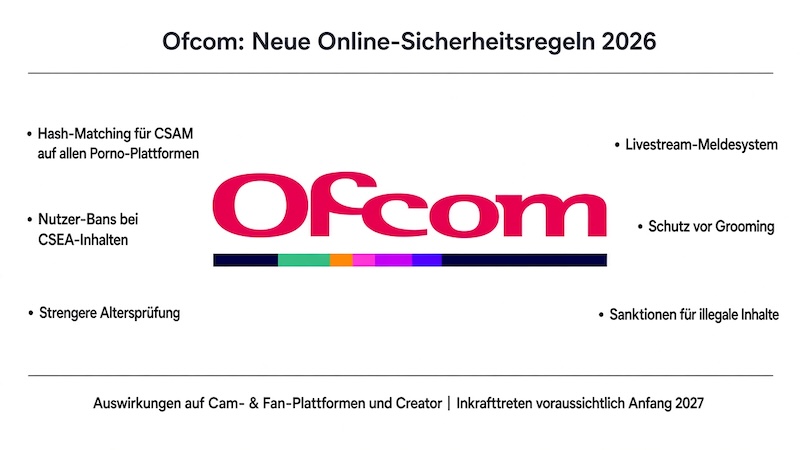
The UK regulator Ofcom published its Statement on Additional Safety Measures on 16 November 2026. It sets out further recommended measures in the Codes of Practice under the Online Safety Act. The clear focus is on protecting children from child sexual abuse material (CSAM) and other illegal content. The rules are especially relevant for pornographic user-to-user services – the category that includes many cam platforms, fan sites and tube sites.
The document (Summary of Chapters) summarises the decisions in each chapter and makes the new requirements concrete. Here is the link to the original document:
https://www.ofcom.org.uk/siteassets/resources/documents/consultations/category-1-10-weeks/consultation-online-safety—additional-safety-measures/statement-main-docs/summary-of-chapters.pdf?v=427943
What is Ofcom?
Ofcom (Office of Communications) is the independent regulator for the communications sector in the United Kingdom. It oversees television, radio, telecommunications and, since the Online Safety Act 2023, large parts of the internet. Its role is to protect users – especially children – from illegal and harmful content. The Codes of Practice issued by Ofcom are technically recommendations, but they function as a “safe harbour”: providers that implement them are generally treated as complying with their legal duties. Those that deviate must demonstrate that their own measures are equally effective – otherwise they risk fines and further enforcement action.
Overview of the Most Important New Rules
Stronger Detection of CSAM
Ofcom is expanding the recommendation to use hash-matching technology. This method identifies already known illegal images and videos via digital fingerprints. What is new is that all regulated user-to-user services whose principal purpose is hosting or disseminating pornographic content should use hash matching – regardless of their size. Ofcom justifies this with the high risk of CSAM circulating on pornographic platforms.
In addition, certain larger or high-risk services should deploy proactive technologies capable of detecting previously unidentified image-based CSAM (for example through machine learning). This requirement does not automatically apply to every porn service; it depends on size and risk assessment.
User Sanctions and Bans
All user-to-user services should permanently ban users who generate, share or upload CSEA content (Child Sexual Exploitation and Abuse). There are exceptions to protect certain child victims. Platforms should also apply sanctions to UK users who share or upload illegal content.
Age Assurance and Child Protection
Existing duties on highly effective age assurance are being strengthened. Platforms that do not want to apply grooming-protection measures to all users must use effective age assurance to identify which accounts belong to children and protect those accounts accordingly. Illegal content should be kept out of children’s recommender feeds.
Livestreaming
Services offering one-to-many livestreaming must provide a reporting mechanism that allows users to flag streams depicting an imminent risk of physical harm (including animal cruelty). Ofcom has withdrawn proposals that would have restricted certain interactions (comments, gifts, recording) on children’s livestreams – partly with reference to planned government restrictions on social-media access for under-16s.
Impact on Providers of Adult Platforms, Cam Sites and Fan Platforms
Cam platforms and fan sites (OnlyFans-style models, live-interaction cam sites) are typically user-to-user services with a pornographic focus. They therefore fall directly within the scope of the expanded hash-matching requirement and the user-ban rules.
Practical consequences for providers:
- Technical investment: Hash matching and, where applicable, proactive detection systems must be integrated and continuously maintained. This covers public uploads and, where technically feasible and in scope, other content. Small platforms are not exempt.
- Moderation and compliance effort: Stricter sanctions policies require clearer processes, documentation and appeals procedures. Incorrect bans can create legal and reputational risks.
- Costs and resources: Ongoing costs for technology, staff and legal advice will rise, especially for smaller or mid-sized providers. Ofcom considers the measures proportionate, including for smaller services that present the relevant risk.
- Enforcement risk: Ofcom has already issued fines against porn services for failures on age assurance. The new measures are expected to take effect from early/spring 2027 (after the parliamentary process). Non-compliance can be costly.
Platforms that already have highly effective age assurance in place are better positioned. Those that have so far relied on minimal measures face increased pressure.
Impact on Camgirls and Creators
Creators themselves are not the direct addressees of the Ofcom Codes, but they will feel the effects clearly:
- Stricter content checks: Hash matching and proactive systems can lead to more automated removals or reviews – including of legal adult content if the technology produces false positives. Creators may need to submit more material for pre-review or keep alternatives ready.
- User bans and community effects: Fans or other creators who post illegal content will be banned more consistently. This can change community dynamics and affect the earnings of individual creators when important fans are removed.
- Age assurance and access: Even more robust age-assurance systems can raise the barrier for new fans and dampen traffic. At the same time they protect creators from the risk of minors accessing their content.
- Livestream specifics: Camgirls who stream live should expect reports of “imminent physical harm” to be examined more quickly. The platform must provide the relevant reporting tools.
- Workload and uncertainty: Creators may need to engage more closely with their platform’s moderation rules, file appeals, or consider moving to platforms that implement the rules differently.
On the positive side, clearer and stricter rules against CSAM and grooming can improve the industry’s long-term reputation and reduce the risk that legitimate adult platforms become entangled with illegal content.
Conclusion and Next Steps
The Statement of 16 November 2026 is not new legislation; it is a further concretisation of the Codes of Practice. Once the parliamentary process is complete, the measures will become more binding. Ofcom has already announced that in spring 2027 it will consult on further proposals for proactive technologies covering a wider range of harms.
Providers of cam and fan platforms should now assess which measures apply to their specific service, evaluate technical solutions and update their policies and appeals processes. Creators should monitor their platforms’ communication channels and seek clarification early when rules are unclear.
FAQ
When do the new measures take effect?
Expected from early 2027 once the parliamentary process is complete. Ofcom intends to drive compliance quickly thereafter.
Do the rules also apply to small cam or fan sites?
Yes. There is no minimum size threshold for hash matching on pornographic user-to-user services. Other measures depend on risk and functionalities.
Do creators themselves have to implement hash matching?
No. The duty falls on the platform operators. Creators are affected indirectly when their content is checked automatically.
What happens if a platform does not implement the recommendations?
It must demonstrate that alternative measures are equally effective. Otherwise it risks investigation and fines by Ofcom.
Are there exceptions for private messages or premium content?
Hash matching primarily targets publicly communicated, regulated user-generated content. The exact scope depends on technical feasibility and the wording of each measure.
How does this differ from the existing age-assurance obligation?
Highly effective age assurance was already required for pornographic content. The new rules add CSAM detection, user bans and livestream reporting.
