

Also available in:
 Deutsch (German)
Meta’s settlement with dozens of U.S. states is more than an expensive legal resolution. With payments of up to around $18 billion over ten years and binding product changes to Facebook and Instagram, the platform environment is shifting for creators who build a fanbase on Instagram and use Linktrees or similar tools to direct traffic to OnlyFans, Fansly, or other adult profiles. For many in the adult industry who have relied on Instagram as a key discovery and traffic channel, the room to maneuver is getting tighter.
What Is Changing in Concrete Terms
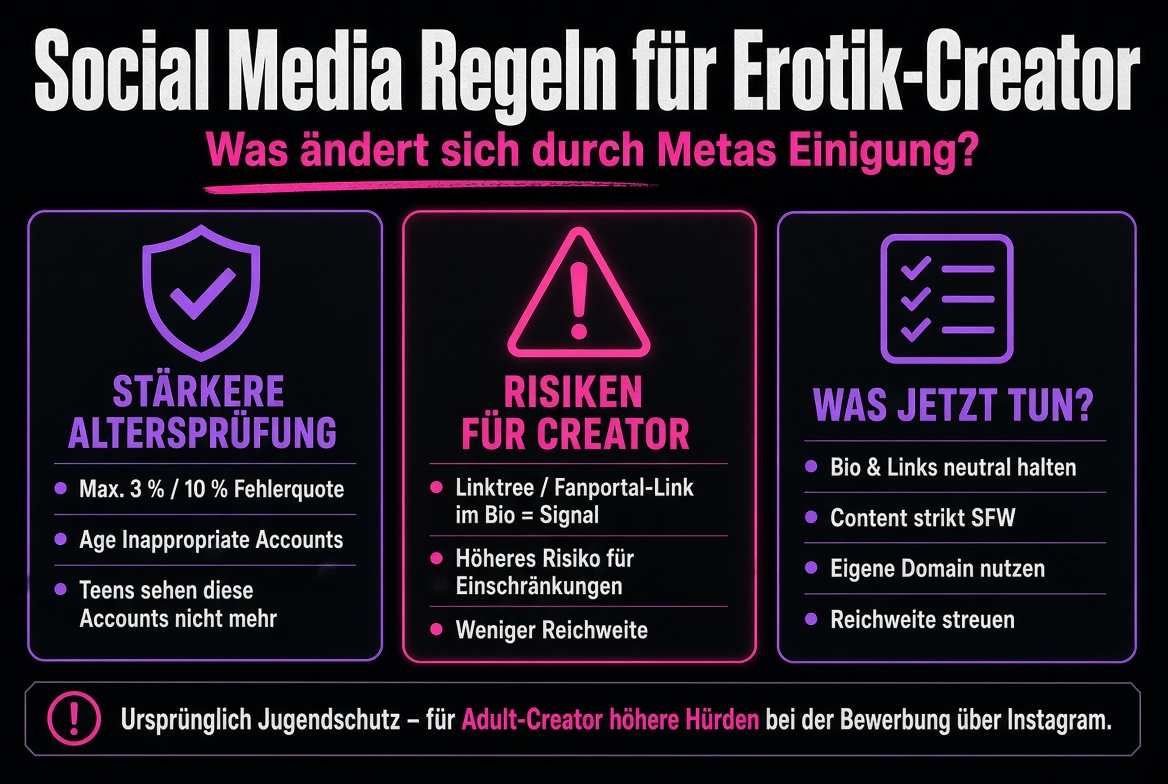
Meta has committed to significantly more robust age assurance. The system is designed to consistently remove users under 13 and place 13- to 17-year-olds into Teen Accounts even when they provide an adult birthdate. Error rates are binding: a maximum of 3 percent of 13- to 15-year-olds and 10 percent of 16- to 17-year-olds may be incorrectly classified as adults. The system will be independently tested and audited.
At the same time, clearer rules apply to “Age Inappropriate Accounts.” An account falls into this category if it regularly posts content from the Adult Nudity & Sexual Activity categories — or if the name, profile picture, or bio (including links) indicates that the account is unsuitable for minors. Teens will no longer be able to follow, view, or interact with such accounts. Users who state they are over 18 but do not complete age assurance will by default be treated as teenagers.
Additional hard usage restrictions for under-18s include a cumulative daily limit of two hours across Facebook and Instagram, nighttime blocks, muted notifications, and further default settings. Most of these requirements apply for ten years in the participating U.S. states and will influence Meta’s global systems.
Direct Impacts on Adult Creators
For creators who use Instagram as an entry point and link from there via Linktree, Beacons, or comparable tools to adult offers, several concrete risks arise:
- Bio links as a signal
A Linktree that clearly points to OnlyFans or similar platforms can, in combination with profile picture, bio text, or content, be treated as an indicator of adult content. This increases the likelihood that the Instagram account will be classified as age-inappropriate. Consequence: Teens no longer see the account, organic reach declines, and the account comes under stronger moderation scrutiny. - Stricter separation of teen and adult experiences
Improved age verification ensures that more users are correctly identified as minors. At the same time, adult accounts are more actively shielded from this user group. Those who previously benefited from mixed or unclearly age-verified reach must expect losses. - Higher risk of account restrictions
Existing Community Standards against sexual solicitation and links to pornographic sites remain in place. The settlement makes enforcement more robust because Meta must meet measurable accuracy targets and independent audits. Creators have already reported shadowbans and reach losses for bio links to adult sites for some time — this pressure is likely to increase. - Less gray area
Suggestive but formally permitted content combined with a clear adult link in the bio becomes riskier. Meta now has stronger incentives and technical means to consistently treat such combinations as unsuitable for teens.
What Creators Need to Watch More Closely Going Forward
To minimize risks, adult creators should adjust their Instagram strategy:
- Keep bio and links as neutral as possible. Avoid direct or easily recognizable references to OnlyFans in the bio. Many creators are already moving the link into Story Highlights or using their own custom domains instead of shared Linktree domains that automated systems can more easily detect.
- Keep content consistently SFW. The cleaner and less suggestive the Instagram profile appears, the lower the chance of being classified as age-inappropriate. Suggestive images, texts, or hashtags in combination with adult links remain the biggest vulnerability.
- Critically evaluate link-in-bio tools. Shared domains (Linktree, Beacons, etc.) can serve as a signal. Own domains or tools with an age gate and more neutral presentation are currently considered somewhat safer, but they are not a free pass.
- Diversify reach. Instagram remains useful for discovery but should not be the only or primary traffic channel. Own mailing lists, alternative platforms, and direct fan communication reduce dependency.
- Prepare for account monitoring and appeals. Respond quickly and with documentation if restrictions occur. The settlement provides for appeals processes — creators should know how to challenge an incorrect classification as a minor account or age-inappropriate account.
- Plan long-term. Most of the new rules apply for ten years. Those who adjust their strategy now will be better positioned than those who continue to rely on the previous gray area.
The platform remains relevant for many creators because it still offers significant organic reach. However, the settlement shifts the balance: anyone promoting adult offers must treat Instagram even more clearly as a pure SFW discovery channel and keep the actual monetization step firmly outside Meta’s platforms.
The original legal dispute concerned the protection of young people. For adult creators, the outcome primarily means one thing: the technical and moderation barriers to indirectly promoting adult offers via Instagram are becoming higher and more permanent.
Source: Meta’s official announcement of the agreement
