

Also available in:
 Deutsch (German)
The adult industry is experiencing one of the fastest transformation phases in its history due to generative AI. Providers of platforms, tools, and content face a field of tension between technological opportunities and concrete legal as well as economic risks. Particularly sensitive are questions of copyright in training data, liability for deepfakes, the reactions of payment providers, and the long-term effects on the monetization of real creators. The following overview summarizes the situation as of late 2026 — without blanket condemnation or glorification of the technology.
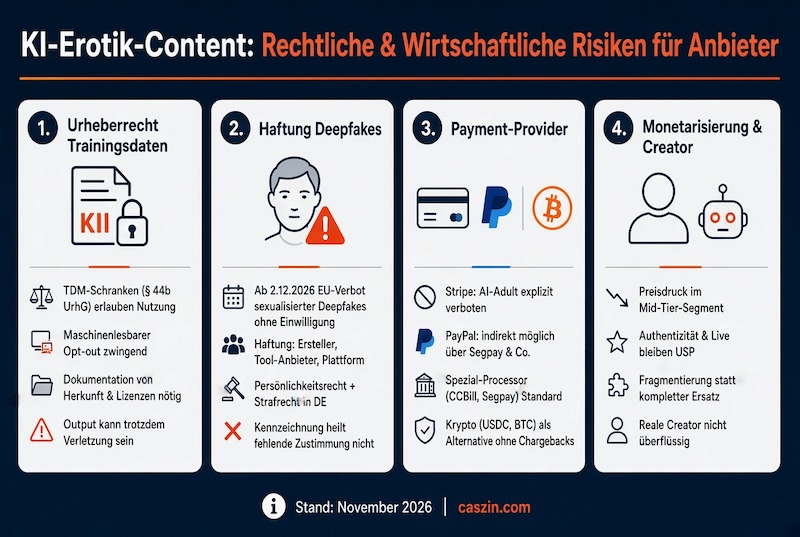
Copyright in Training Data: Exceptions, Opt-Outs, and Limits
May an AI freely use any data from the internet for erotic images or texts? In the European Union and Germany the answer is: basically yes under strict conditions, but not unrestricted.
The text and data mining exceptions (§ 44b German Copyright Act and Art. 4 of the DSM Directive) permit the automated analysis of lawfully accessible works for commercial purposes as well. German courts confirmed this in the LAION proceedings: the Hamburg Regional Court (2024) and the Higher Regional Court of Hamburg (2025) regarded the creation of training datasets as covered by the exceptions, provided no effective machine-readable reservation of rights (opt-out) exists.
The EU AI Act reinforces this logic. Providers of general-purpose AI models must implement a strategy to detect and respect opt-outs under Art. 4(3) of the DSM Directive — including by means of state-of-the-art technologies. A mere clause in the terms of service is not sufficient; the reservation must be machine-readable.
Additional risks arise in the erotic sector. Publicly accessible photos and videos are protected by copyright. Training on them without a license or despite an opt-out can give rise to claims for injunction and damages. Data-protection rules (GDPR) also apply when personal or sensitive data are involved. Purely AI-generated outputs are generally not themselves protected by copyright because they lack human authorship. If, however, they recognizably reproduce protected works or styles, this may constitute an adaptation requiring consent.
Practical consequence for providers: anyone training their own models or performing fine-tuning should document the origin, licenses, and opt-out status of the data. Users of third-party models often bear the risk for the output themselves.
Liability for Deepfakes: Who Is Responsible for Non-Consensual Erotic Depictions?
The generation of erotic deepfakes of real persons without their consent is one of the sharpest legal minefields. From 2 December 2026, explicit bans apply in the EU: AI systems that can generate or manipulate realistic intimate depictions (genitals, breasts, sexually explicit acts) of identifiable persons without free, specific, informed and explicit consent are prohibited. This also covers depictions of child sexual abuse. The rule captures not only systems purpose-built for this but also those for which such misuse is reasonably foreseeable and reproducible.
In Germany, personality rights, the right to one’s own image, and expanded criminal provisions apply in parallel. In 2026 the federal cabinet adopted penalties for the unauthorized creation and dissemination of sexualized deepfakes; even production for private use can be punishable. Civically, affected persons can demand injunction, deletion, and monetary compensation. Platforms are subject to the Digital Services Act (notice-and-action).
Liability in practice falls on several actors: the person who creates or commissions the deepfake; the provider of the AI tool if the misuse was foreseeable and adequate protective measures were not implemented; and platforms that host the content and fail to act after obtaining knowledge. Labeling the material as “AI-generated” does not cure the lack of consent.
For providers this means: technical and organizational measures against non-consensual intimate imagery (NCII) are mandatory. Anyone operating tools or platforms that enable realistic erotic depictions must carefully examine and document the intended purpose, training data, and user functions.
Payment Providers: Higher Barriers, Indirect PayPal Routes, and Crypto Options
Billing for both AI-generated and real erotic content remains high-risk. Mainstream providers such as Stripe list adult content (including AI-generated pornographic or sexually intended material) as prohibited. Stripe explicitly includes “any artificial-intelligence-generated content that meets the above criteria.”
PayPal is restrictive regarding digital adult content and in many cases requires prior approval or refuses it outright. Nevertheless, practical indirect routes now exist for providers of real erotic content: specialized high-risk processors such as Segpay can enable PayPal as a payment method for their merchant accounts. The end customer then sees PayPal alongside cards on the payment page; processing runs through the processor, which acts as merchant of record. Segpay documents this in its own integration guides. The possibility is not universal and depends on the processor’s activation, the content model, and the jurisdiction — but it is real and is being used.
Specialized providers (CCBill, Segpay, Epoch, Verotel and others) remain the standard route. They typically require proof of age verification/consent, content monitoring, higher fees (often 9–15 percent plus reserves), and ongoing compliance. Mastercard and Visa rules apply equally to generated and hybrid content: missing consent for recognizable real persons or non-consensual deepfakes can lead to account termination.
Cryptocurrencies constitute a genuine alternative or complement. Many adult sites and creators accept Bitcoin, USDT, USDC and other coins via their own wallets, gateways such as NOWPayments, or specialized solutions. Advantages: no chargebacks, reduced dependence on card networks and banks, often lower fees, and faster settlement. Pornhub and some fan platforms actively use crypto. OnlyFans itself does not support crypto natively for fans or payouts — external tip links or alternative platforms fill the gap. Disadvantages: lower adoption among parts of the customer base, price volatility (lower with stablecoins), tax and AML requirements, and the need to manage wallet and conversion processes oneself or through a service provider. Crypto does not fully replace traditional payment providers but significantly reduces dependence on them.
For AI content the same or stricter checks apply: synthetic-content policies, abuse prevention, and consent documentation are examined more intensively. A “special agreement” and ongoing audits are the norm.
Does AI Content Destroy Monetization?
The economic threat to real erotic creators is real but differentiated. Fully synthetic accounts and high-volume AI-assisted profiles compete especially in the mid-tier segment: they post more frequently, at lower prices, and without physical or emotional strain. On platforms that allow AI creators (for example Fanvue), growth is noticeable. OnlyFans itself permits AI content only to a limited extent — linked to a verified human creator and clear labeling — and rejects fully synthetic profiles.
The result: price pressure and fragmentation of attention. Many creators report stagnating or declining revenues in the mid-price range. At the same time, human interaction, authenticity, and live experience remain decisive differentiating factors. Some established performers already use AI productively (efficiency gains, their own licensed digital clones) or demand contractual opt-outs against training on their material.
In the long term a complete replacement is not expected, but rather a fragmentation of the market: one segment for cheap, mass-produced synthetic content and a premium segment for genuine human connection. Whether the revenues of real creators overall shrink or merely redistribute depends on the ability of platforms and creators to keep authenticity visible and value-creating. Anyone relying solely on interchangeable visual content is under particular pressure.
Conclusion: Risk Management Instead of Technology Ban
AI-generated erotic content is neither categorically illegal nor risk-free. Providers must take copyright and data-protection rules for training data seriously, strictly observe deepfake bans and personality rights, and treat payment compliance as a strategic task. Indirect PayPal routes via specialized processors and crypto options expand billing possibilities but do not replace clean compliance. At the same time, market developments show that human creators will not become superfluous — as long as they emphasize the elements that AI (still) cannot credibly replace.
For the industry the rule is: those who know and document the legal and economic guardrails can seize the opportunities. Those who ignore them risk cease-and-desist letters, account suspensions, and revenue losses.
Further information:
- EU AI Act – Prohibited practices and transparency obligations (eur-lex.europa.eu)
- Segpay Merchant Portal / PayPal Integration Guide (gethelp.segpay.com)
- Mastercard Adult Content Rules and compliance requirements (via specialized processor sites or card-network documentation) https://mobiuspay.com/blog/mastercard-adult-content-rules
- Hamburg Regional Court / Higher Regional Court decisions on AI training and TDM exceptions (case-law databases or specialist portals such as itmr-legal.de)
- Overviews of high-risk payment processors and crypto options for adult (current industry guides on CCBill, Segpay, NOWPayments, etc.) https://tubepress.io/guides/adult-payment-processors
