

Also available in:
 Deutsch (German)
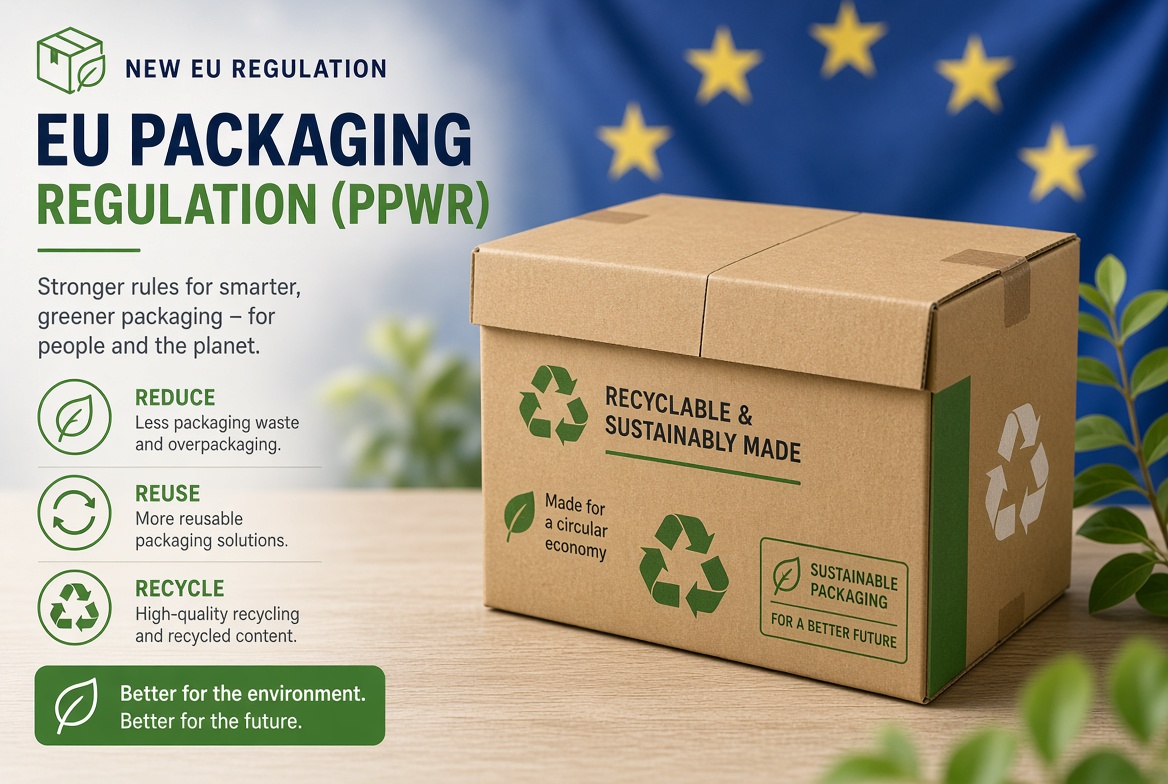
While large corporations maintain entire departments for compliance, many small and medium-sized online retailers of sex toys, erotic magazines and accessories are struggling with a set of rules that complicate their daily operations and disrupt their calculations. Since 12 August 2026, the Packaging and Packaging Waste Regulation (PPWR, Regulation (EU) 2025/40) has applied directly in all EU Member States. What is being sold as a contribution to the circular economy is turning out for many shippers to be expensive and opaque bureaucracy – especially for those who use discreet shipping boxes and neutral envelopes.
The Core of the Problem: Who Is the “Producer”?
The PPWR distinguishes between manufacturers (who are liable for design and conformity) and producers (who bear extended producer responsibility – EPR). The decisive factor is who “makes available” packaging for the first time in a Member State. Even a single shipping carton or a large envelope for magazines counts. There is no de minimis threshold. For small retailers this means: registrations, volume reports, fees and often authorised representatives – per country.
The material requirements (recyclability, minimisation of empty space and material, later labelling obligations) apply to everyone in any case. From 2030 things will get even tighter: a maximum of 50 percent empty space for e-commerce packaging, stricter recyclability requirements and recycled content quotas.
The Scenarios at a Glance – What Retailers Specifically Face
1. Based in Germany, shipping only to German customers
This is the comparatively most favourable scenario. For neutral standard shipping cartons or envelopes purchased from a German supplier and not bearing the retailer’s own logo, EPR responsibility often rests with the packaging manufacturer. The retailer frequently no longer has to license this standard packaging themselves.
The situation is different for the product packaging (the box or film around the toy itself) or for individually printed/branded shipping packaging: here the retailer remains the producer and must register in the LUCID register of the ZSVR, report volumes and participate in a dual system. Anyone who imports goods from China and only resells them in Germany is also regarded as an importer and therefore as a producer in Germany – with full EPR obligations.
2. Based in Germany, shipping to other EU countries
This is where it becomes expensive and time-consuming. Anyone who ships directly to end customers in France, Italy, the Netherlands or Spain becomes the producer of the packaging in the respective destination country. The consequence: registration in the national producer register of every country supplied, volume reporting, EPR fees – and the mandatory appointment of an authorised representative on site. One authorised representative for the entire EU is not sufficient. Even a few shipments per country can trigger the obligation. For small shops that ship discreetly across Europe, this quickly adds up to several hundred euros per country and year – plus administrative effort.
3. Direct shipping from China (or another third country) to EU customers
Chinese or other non-EU sellers who ship toys or magazines directly to European end customers are explicitly regarded as producers. They must be registered in every Member State they supply and appoint an authorised representative. Online marketplaces are obliged to check the registration and can block offers. In practice, enforcement against pure China-based shops is more difficult than against EU retailers, but the legal obligation exists – and platforms are becoming stricter.
4. German resellers who source goods from China and only deliver within Germany
The German importer/reseller is generally the producer in Germany. They bear full EPR responsibility for both product and shipping packaging, must ensure LUCID registration and system participation, and verify the conformity of the packaging coming from China (obtain evidence from the supplier). No authorised representatives in other countries are required – but the administrative and financial burden remains.
The shipping of erotic magazines in large envelopes is also covered. The envelopes are transport or e-commerce packaging. For neutral standard products from German suppliers, the shipper often no longer has to license them themselves; this does not apply to individualised envelopes or cross-border shipping.
Criticism and Lawsuits – Not Only from the Erotica Industry
The PPWR is being criticised well beyond the erotica sector. Trade associations, packaging manufacturers and industrial companies complain about the enormous bureaucratic effort, lack of clarity in definitions and the burden especially on small and medium-sized enterprises. In spring 2026, numerous companies (including major names from the food and packaging industries) called for delays to individual deadlines, for example regarding PFAS limits. Environmental organisations disagreed and pushed for timely implementation.
As early as 2025, several companies filed actions for annulment with the General Court of the European Union (including T-239/25, T-242/25, T-247/25 and others). They are seeking the annulment of the entire regulation or of key bans (Article 25 and Annex V on certain single-use formats as well as parts of the reuse targets). Their arguments: incorrect legal basis, violation of the principle of equal treatment and disproportionality. So far the lawsuits have not suspended the applicability of the regulation.
For small erotica retailers, who often work with tight margins and discreet shipping solutions, the regulation remains an additional cost and risk factor. Anyone who ignores the obligations risks fines, sales bans or being blocked by marketplaces.
What to Do?
Carefully review your supply chain and shipping countries. Prefer neutral standard packaging where possible. Organise registrations and authorised representatives early. And keep an eye on developments in the pending lawsuits as well as the Commission’s FAQs and guidance documents – the interpretation is still evolving.
The circular economy is an important goal. However, the way the PPWR burdens smaller shippers in particular appears excessive and impractical. Many retailers will restrict Europe-wide shipping or pass the additional costs on to customers – with noticeable consequences for the market.
Helpful Links
- Official FAQ of the European Commission on the PPWR: https://environment.ec.europa.eu/publications/faq-packaging-and-packaging-waste-regulation-ppwr_en
- Commission Guidance Document: https://environment.ec.europa.eu/publications/guidance-document-packaging-and-packaging-waste-regulation-ppwr_en
- LUCID Packaging Register (Germany): https://lucid.verpackungsregister.org/ and https://www.verpackungsregister.org/
- EUR-Lex text of Regulation (EU) 2025/40: https://eur-lex.europa.eu/legal-content/EN/TXT/?uri=CELEX:32025R0040
- Information from the ZSVR on producers and authorised representatives: https://www.verpackungsregister.org/
