


Also available in:
 Deutsch (German)
Rarely has a court so clearly rebuffed German media regulators’ attempts at censorship as it has done this time. At the end of 2025, the Düsseldorf Administrative Court already ruled that the revised version of the Interstate Treaty on the Protection of Minors in the Media (JMStV) violated applicable EU law (CASZIN reported). The Administrative Court in Neustadt an der Weinstraße has now gone one step further: its latest ruling effectively calls into question the entire approach taken by media authorities (in this case Rhineland-Palatinate) to date. The blocks imposed by media regulators in 2024 on sites operated by Aylo (YouPorn, Pornhub, etc.) are therefore unlawful.
The original press release from the court itself could hardly be clearer:
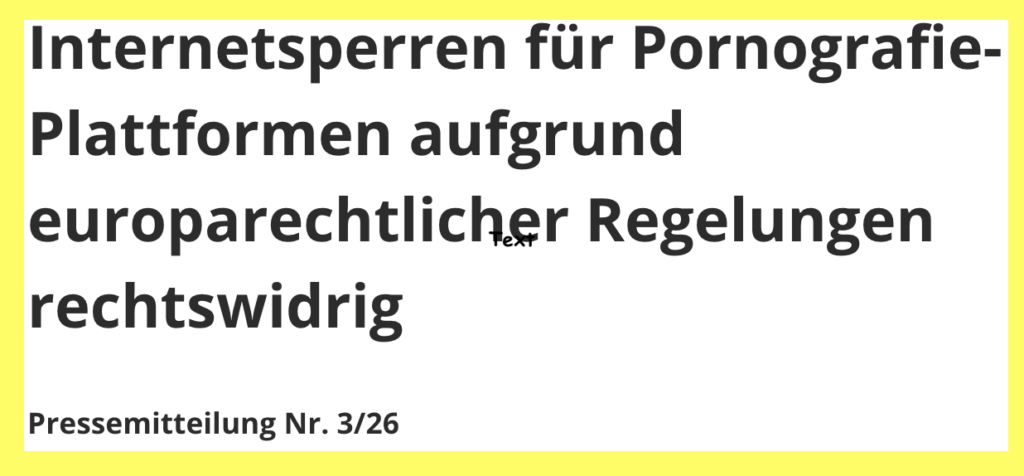
The Media Authority of Rhineland-Palatinate had urged several access providers in Germany to block access to Aylo’s websites by means of DNS blocking. The reason given for this was alleged violations of the German Interstate Treaty on the Protection of Minors in the Media (JMStV), because the websites in question did not use adequate age verification systems.
Judge: Media regulators acted unlawfully
However, the judges have now overturned these measures as unlawful. The core of their reasoning is that the German blocks violate the EU country of origin principle and contradict the overriding European regulatory framework – in particular the Digital Services Act (DSA). Under these conditions, unilateral action by individual nation states regarding access to cross-border websites is not permissible.
The orders issued by the Media Authority also violated the so-called country of origin principle. According to this principle, providers of digital services are generally only subject to the laws of the EU member state in which they are based – in this case, the Republic of Cyprus. Other EU member states – such as the Federal Republic of Germany – may deviate from this in individual cases. However, this is only possible under strict conditions.
Press release from the Neustadt Administrative Court
The judges also did not consider the strict conditions to be met. The court also clarified that the DSA now constitutes a uniform and comprehensive set of rules for the digital single market and largely places responsibility for enforcing youth protection standards on the internet at EU level. National authorities cannot apply German blocking rules at their own discretion against operators based in other Member States, such as Cyprus.
The court’s original ruling speaks for itself:
Ultimately, the enactment of the disputed regulations cannot be directly based on the provisions of the DSA. In this respect, too, it must be assumed that Cypriot authorities have primary jurisdiction. Irrespective of this, action by the state media authority against one of the platforms classified as a ‘very large online platform’ within the meaning of Article 33(1) DSA is also ruled out because the European Commission has already initiated its own proceedings in this regard, thereby establishing the Commission’s exclusive jurisdiction.
The superior beats the subordinate
The reference to the fact that European rules also apply even if German laws stipulate stricter youth protection requirements is particularly controversial from a legal perspective. The Administrative Court has allowed an appeal to the Higher Administrative Court of Rhineland-Palatinate, which makes the decision even more controversial: a follow-up by the highest court could further clarify the legal situation and finally remove the authority of national authorities over such measures.
Appeal to the Higher Administrative Court expressly permitted
In a possible next round – if there is one – things could become even tighter for the guardians of public morality. A higher regional court could completely revoke the right of German authorities, such as state media authorities, to issue such blocking orders. Until then, the blocks are now history in any case.
More Infos:
