

Also available in:
 Deutsch (German)
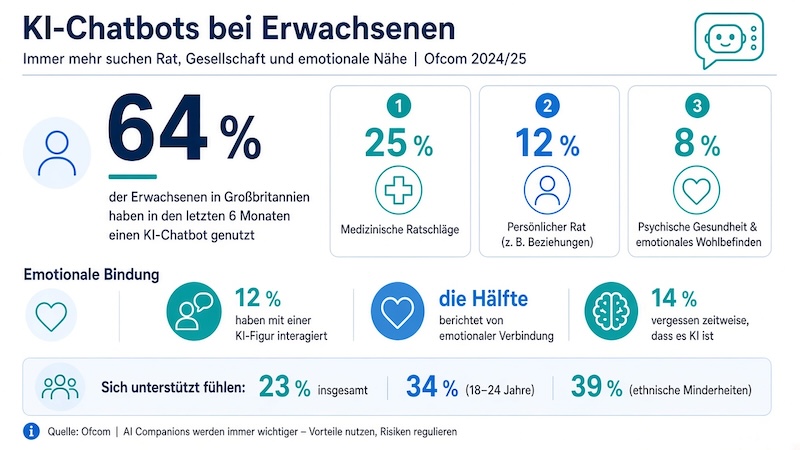
New figures from the British regulator Ofcom show that AI chatbots are no longer just a tool for the younger generation. 64 percent of adults in the United Kingdom have used an AI chatbot in the past six months. What is particularly striking is what many of them use the systems for – not only for practical questions, but increasingly for personal advice, medical information and even emotional support.
Adults are using chatbots far beyond classical search
Among adult chatbot users, 25 percent said they had already sought medical advice. 12 percent used the systems for personal advice, for example on relationships. A further 8 percent sought support for mental health or emotional well-being.
Half of the adults who use chatbots for advice or conversation do so at least partly because the technology responds faster than friends. Constant availability appears to be a central motive.
Emotional attachment to AI characters is growing
Particularly interesting is the way people interact with AI characters. 12 percent of adult chatbot users have already interacted with an AI-generated character. Half of them report an emotional connection – 16 percent even a very strong one. Roughly one in seven (14 percent) sometimes forgets that they are dealing with artificial intelligence and not a real person.
Younger adults between 18 and 24 as well as people from ethnic minorities feel particularly frequently supported by their chatbots. While overall 23 percent of adult users say they feel supported by the systems, the figures rise to 34 percent among 18- to 24-year-olds and 39 percent among members of ethnic minorities.
The rise of AI companions
More and more people are using chatbots not only as a tool, but as a form of companionship – both through general AI systems and through applications specifically designed as companions. These “AI companions” can give advice and help with emotional topics. At the same time they carry risks: they can generate harmful content and, through their deliberately human-like behaviour, encourage intensive use. Ofcom notes that the more human-like a chatbot appears, the stronger the user attachment becomes – and the longer the interaction lasts, the more likely adults are to perceive the system as human.
A look at the younger generation
Usage is also high among children and young people: 81 percent of 8- to 17-year-olds have used an AI chatbot in the past six months. Many use it daily for homework, hobbies or as a conversation partner. For the specialist magazine, however, adult usage is the main focus.
Regulation and outlook
Some chatbots are already subject to the British Online Safety Act. The government is planning further tightening, including obligations regarding illegal content and stronger protective measures. Andrew Breeze, Director of Tech Policy at Ofcom, emphasises:
“AI chatbots are becoming an increasingly natural part of everyday digital life. While these tools can offer positive experiences, they also carry risks. It is crucial that we understand how and where children and adults use these services, so that everyone can benefit from them safely and the right protective measures are in place.”
The development clearly shows: for many adults, AI chatbots are already more than a search substitute. They are becoming advisors, conversation partners and, in some cases, even emotional points of reference. The challenge for providers and regulators is to preserve the benefits while getting the risks – particularly those associated with intensive emotional use – under control.
Ofcom publication:
